Big Plans for Uranus - Part 3
A detailed look at the scientific breakthroughs we could expect from an Oberon Baseline Observatory, and what an overall mission might look like that gets us there.
Part 3
In part 1 of this series, we took a high-level tour of the Uranian system, then in part 2 we introduced the idea of the Oberon Baseline Observatory, or OBO. This third and final installment dives deep into the details, exploring the science unlocked by OBO, along with the feats of engineering that would be required to make this mission happen. If you’ve read this far, it’s probably because you like details. Well, here they are.
A Generational Leap in Science
With audacious engineering, comes awe-inspiring payback. The Oberon Baseline Observatory would be a generational leap in scientific capability, and the discoveries it returns would be utterly transformational. The ambitious science payload and unique location in the outer solar system would revolutionize dozens of fields of study.
Astrometry and Galactic/Celestial Mechanics
Future cosmologists and astrophysicists would think in terms of “pre-OBO” and “post-OBO” science. It would be a civilizational watershed
Our current state-of-the-art instrument – the Gaia Space Telescope – uses its 2 AU parallax baseline to be able to see 10 microarcseconds (10 uas) of angular precision. To put that in perspective, that’s so precise that if you (somehow, because it wouldn’t be happy in Earth gravity) installed Gaia on the observation deck of the CN Tower in Toronto, it could resolve two bacteria side-by-side 40km away, on the opposite shore of Lake Ontario. In space terms, this resolution allows Gaia to accurately plot the distance of stars as far away as 10,000 light years – roughly everything in view of Earth’s quadrant of the Milky Way galaxy.
Impressive right? But OBO, using similar state-of-the-art equipment enjoying a 38 AU baseline (along with the ability to integrate decades worth of observations while Uranus slowly orbits the Sun), would be able to discern two bacteria 4000km away, in Medellin, Colombia. This would extend its astronomical reach to every part of the Milky Way galaxy including the galactic halo. We would be accurately plotting star positions and 3D velocities not just inside the Milky Way, but also within the dwarf galaxies, Magellanic clouds, and globular clusters surrounding the galaxy. We might, if OBO performs right at the upper limits of its capability, even be mapping positions and motions for a handful of bright, high-velocity stars in the Andromeda and Triangulum Galaxies, a few million light years away.

But if OBO is aspirational, let’s really aspire and not restrict ourselves to today’s technology. The European Space Agency has proposed a successor to Gaia named Theia, which would include a host of enhancements and optical tricks (namely: interferometric metrology) to improve angular resolution to 0.3 uas even though it would also orbit near Earth with just 2 AU parallax baseline. If OBO included those same enhancements, it could achieve a staggering 25 nanoarcseconds (25 nas) of angular resolution when integrating measurements over 38 AU and dozens of years, precise enough to discern two side-by-side bacteria halfway around the world in Adelaide, Australia (and, to briefly revisit our sidebar from Part 2, deploying a 3-telescope interferometric array would increase this precision further still).
It is impossible to overstate the impact this would have on the science of Astrometry and Celestial Mechanics. Within our quadrant of the milky way, this exquisite level of detail would provide direct observation of things like gravitational waves perturbing star fields, or the tiniest accelerations of stars caused by dark subhalos, rogue black holes, or passing massive objects yet unknown to science. We could “rewind” stellar movements to understand previous interactions with massive objects that might be hidden within the densest parts of the galactic core. We would see our home galaxy not as a static backdrop, but as a dynamic, living structure – one where every star is a test particle in a vast gravitational ballet.
Beyond our galactic neighbourhood, 25 nas resolution would allow us to directly observe large, statistically robust populations of stars within Andromeda and Triangulum, comparing the gravitational dynamics between those two galaxies and our own. For the first time in human history, we could test whether the laws of gravity, dark matter distribution, and galactic evolution are truly universal.
Ultimately, we probably can’t even comprehend the new frontiers of scientific understanding OBO would unlock. Future cosmologists and astrophysicists would think in terms of “pre-OBO” and “post-OBO” science. It would be a civilizational watershed.
Dark Matter and Exotic Physics
With nanoarcsecond-scale angular precision, OBO would become the most powerful dark matter observatory ever built – not by detecting dark matter directly, but by revealing its fingerprints across the cosmos. Subtle, non-Newtonian deviations would jump out like UV-lit stains at a crime scene. And while OBO might not be equipped to directly prove or disprove our theories around dark energy, by allowing us to make fine-grained comparisons between (relatively) local and cosmological acceleration, we will be better able to frame and constrain our ongoing study.
Beyond dark matter, OBO’s extreme positional sensitivity opens the door to exploring exotic physics at the edges of known theory. By monitoring quasars, pulsars, and distant stellar references over decades, OBO could detect anomalies or violations of known physics, opening a door to study hypothetical exotic objects. After a century patiently examining the cosmos, OBO would leave us with a rich and intriguing catalog of millions of candidate sites containing dark matter, theoretical objects, and objects we can’t even theorize today.
Cosmology and Large-Scale Structure
What OBO does for individual stars within our local group of galaxies, it could also do for quasars and other energetic sources in the furthest reaches of the observable universe. By tracking individual motions of quasars and other cosmic trackers, it would bring revolutionary precision to the study of large-scale structure and cosmic kinematics. Several of humanity’s most foundational tenets of modern cosmology might finally be within reach of direct, observational study. It would be our first precision tool for probing the architecture of the universe itself.
Study of High-Energy Phenomena (VLBI radio study)
At 19 AU distance, OBO would function as the most extreme VLBI anchor ever conceived, offering a baseline millions of times longer than any current Earth-based array, and dozens of times longer than any other planned space-based network. The leap in angular resolution would allow us to peer into supermassive black holes, active galactic nuclei (AGNs), and other high-energy environments with unprecedented clarity.
With picoarcsecond resolution in the radio domain, OBO could examine supermassive black holes in extraordinary detail – potentially even mapping subtle structures near the event horizon. By probing millions of energetic objects across the universe, it could test and refine several of our most foundational assumptions about galactic evolution, general relativity, and the interface between gravity and quantum physics.
OBO could examine supermassive black holes in extraordinary detail – potentially even mapping subtle structures near the event horizon
Heliophysics and Stellar Evolution
Stationed in a slower, less energetic region of the heliosphere, where solar influence begins to fade and the interstellar medium starts to push back, OBO would serve as a long-term sentinel of solar wind, magnetic field interactions, and cosmic ray propagation. Over a century of operation, it would observe more than ten full solar cycles, capturing both long-term trends and rare, extreme space weather events from a perspective no other observatory can offer.
Uranus’s extreme axial tilt and off-kilter magnetic field create a uniquely twisted interaction with the solar wind – one that evolves dramatically over its 84-year orbit. From Oberon, OBO could monitor this bizarre magnetic choreography in slow motion, capturing how solar particles, field lines, and shock fronts behave in a skewed, lopsided magnetosphere unlike any other in the solar system. This long-duration dataset would be invaluable not only for understanding Uranus itself, but for modeling stellar wind–magnetosphere interactions in exoplanetary systems.
Interstellar Medium (Brown Dwarves, Rogue Planets, KBOs, Oort Cloud Census)
OBO’s extreme parallax baseline might improve its angular precision, but it will still rely on the light-gathering capabilities of a 4-meter-class telescope, so Brown Dwarves, Rogue Planets, and Oort Cloud Objects far from any sources of light will likely still not be directly visible. However for those that can be imaged, OBO’s angular precision will allow their motion and likely origin to be studied and understood with pinpoint accuracy.
But even “invisible” objects will be conspicuous to OBO in one of several ways:
- The Microlensing Suite is specifically designed to capture any event where an object of sufficient mass transits a background star. Over a century-long operating period, OBO might capture millions of these events.
- The Astrometry Suite, while not designed explicitly for microlensing detection, would still be able to see and measure serendipitous microlensing events occurring within its field of view. In fact, because the astrometry suite contains both a visible/IR camera and a UV camera, valuable additional data would be collected when invisible masses transit certain types of background objects such as white dwarves. By capturing both optical and UV astrometric shifts and photometric curves, OBO can disentangle lensing geometries, identify exotic lens types, and more accurately characterize the foreground object’s mass, distance, and type.
- The Astrometry Suite will observe billions of star trajectories over its lifespan. Even when no microlensing events are occurring, any otherwise “unexplainable” gravitational disruptions would point strongly toward the presence of a dark object. OBO’s exquisite nanoarcsecond sensitivity would allow it to detect a Jupiter-sized rogue planet passing within ~300 AU (ten times further than Neptune orbits from our Sun) of any stars in our galactic neighbourhood.
Finally, OBO would help us better understand Kuiper Belt Objects (KBOs) in the distant reaches of our Solar System. If gravity is the only force affecting these objects, they will behave in predictable ways, but if outgassing (or other, more mysterious forces) are causing them to drift, OBO will detect it. The fact Uranus sweeps a full 360 degree arc over the span of its 84 year orbit means OBO can act as a spotlight, closely examining every sector of the Kuiper belt as it moves.
Over a century-long operating period, OBO might capture millions of microlensing events
Exoplanet Discovery and Characterization
There are roughly 1000 “Sun-like” stars (F, G, and K class) in our galactic backyard (the space within 100 light years of our Sun). If there are Earth-sized planets in the habitable zone around any of them, OBO would be capable of detecting many of them – especially for those within 50 light years – via the tiny reflex wobbles they induce. Super-Earths and Mini-Neptunes would be detectable out to a distance of a few hundred light years. Jupiter-sized planets would be detectable out to a thousand light years or more – though at those distances many stars are obscured by dust or other factors. But that still leaves millions of F, G, and K class stars that are visible from Earth. In other words, if it’s in our galactic neighbourhood and OBO can see it, OBO could tell us whether there’s a large gas giant in that system.
Within 25 light years, there are several dozen Sun-like stars, and at these distances, OBO wouldn’t just tell us about the presence of Earth-like planets, it would have sufficient power and precision to fully characterize each solar system. For example if OBO were located 25 light years away and it looked back at our Sun, it would be able to say “G2 star with 4 rocky inner planets of roughly these masses. 4 outer planets, two of them gas giants, and two ice giants further away.” It would detect all of that just from the subtle wobbles each planet induces as it circles the sun. The only thing OBO won’t read is exoplanet atmospheres – that work is best left to other kinds of telescopes that can directly image an exoplanet. But OBO will tell us exactly where to point those telescopes.
Technosignature Detection
What if humans aren’t the only advanced intelligence in the universe? We’ve been seeking answers to this question probably since the dawn of human language and myth, and OBO would bring some powerful new technologies to the inquiry. Let’s break the hunt down into three broad categories:
SETI would detect, then OBO would localize with absurd precision.
First there are conventional “someone is broadcasting something” or “someone altered their planet in some weird way” technosignatures. OBO’s VLBI radio node – with its 3 billion kilometer baseline and picoarcsecond resolution – would be able to triangulate and pinpoint radio sources with staggering accuracy. Where today’s SETI instruments might say “there is a distinctly unnatural signal originating near that star system 83 light years away”, a VLBI array with OBO at one end would be able to say “that signal is consistently coming from the 4th planet in the system as it traces its orbit around the star.” SETI would detect, then OBO would localize with absurd precision.
Second, OBO’s astrometry suite would play a role by combing through gravitational evidence. It might not directly detect technosignatures (radio broadcasts, atmospheric anomalies, etc.) but it has the angular precision to find kinematic anomalies and photometric effects that might point to:
- Dyson spheres (either complete or partial) disrupting nearby stars
- Unusual solar system architectures
- Massive satellite swarms or megastructures causing unnatural occultation patterns around a host star
- “Station keeping” behaviours that break the laws of standard Keplerian motion
Finally, there is the biggest technosignature of them all – something that originates not within the universe but outside it: what if we’re living in a simulation? What if everything we see, measure, and experience is being rendered inside a giant machine or computer beyond our imagining? While seemingly fringe, this is a legitimate hypothesis put forward by some serious scientists. If true, OBO might be the first tool humans devise that’s capable of pulling aside the curtain. You see, if everything we experience is a rendering, then that rendering might have a resolution limit. The algorithms encoding our reality might exhibit ever-so-slight “step function” behaviours rather than being infinitely smooth. OBO could, potentially, discover subtle violations of things like General Relativity, or inertial frame consistency, or proper motion smoothness. There might be tiny nanoarcsecond-level glitches in the universe that shouldn’t exist under standard physics.
We’ve long imagined how humanity might respond to evidence of another civilization in our universe. Books, films, and religions have wrestled with the idea. But how would we – both collectively and individually – respond to the revelation of intelligence outside our universe? Something examining us, measuring us, and orchestrating our reality? Who’s running the simulation and why? Is it a game? A test? Are there winning conditions or losing ones? Is there a timer? OBO almost certainly would be unable to answer these questions, but it might compel us to ask them.
Gravimetry and Fundamental Physics
Gravity is the oldest force we've studied, and yet it remains surprisingly elusive. Newton gave us its equations, Einstein reshaped its foundations, and yet neither fully explains the deepest mysteries of the cosmos. From dark matter to cosmic acceleration, from galactic rotation curves to the edges of spacetime, scientists are increasingly asking whether General Relativity – elegant though it is – might be incomplete.
By studying and mapping proper motions for billions of stars within our local group of galaxies, and the stellar streams that link them like luminous tendrils of light, OBO would finally give us a tool to measure the “edge cases” of gravitational theory: long timescales, large distances, and weak fields. We would finally have a tool that can tell us whether, when, and how our fundamental physics break down.
Mission Precursors – What Must Come Before OBO
We’ll talk more about costs in the next section, but it goes without saying that any mission as audacious as OBO would be expensive. It’s not the sort of thing you launch with fingers crossed, having never studied the environment in which you plan for it to operate – completely autonomously – for a century or more. At minimum, two precursor missions would be sent to Uranus ahead of time.
Uranus Orbiter and Probe (UOP)
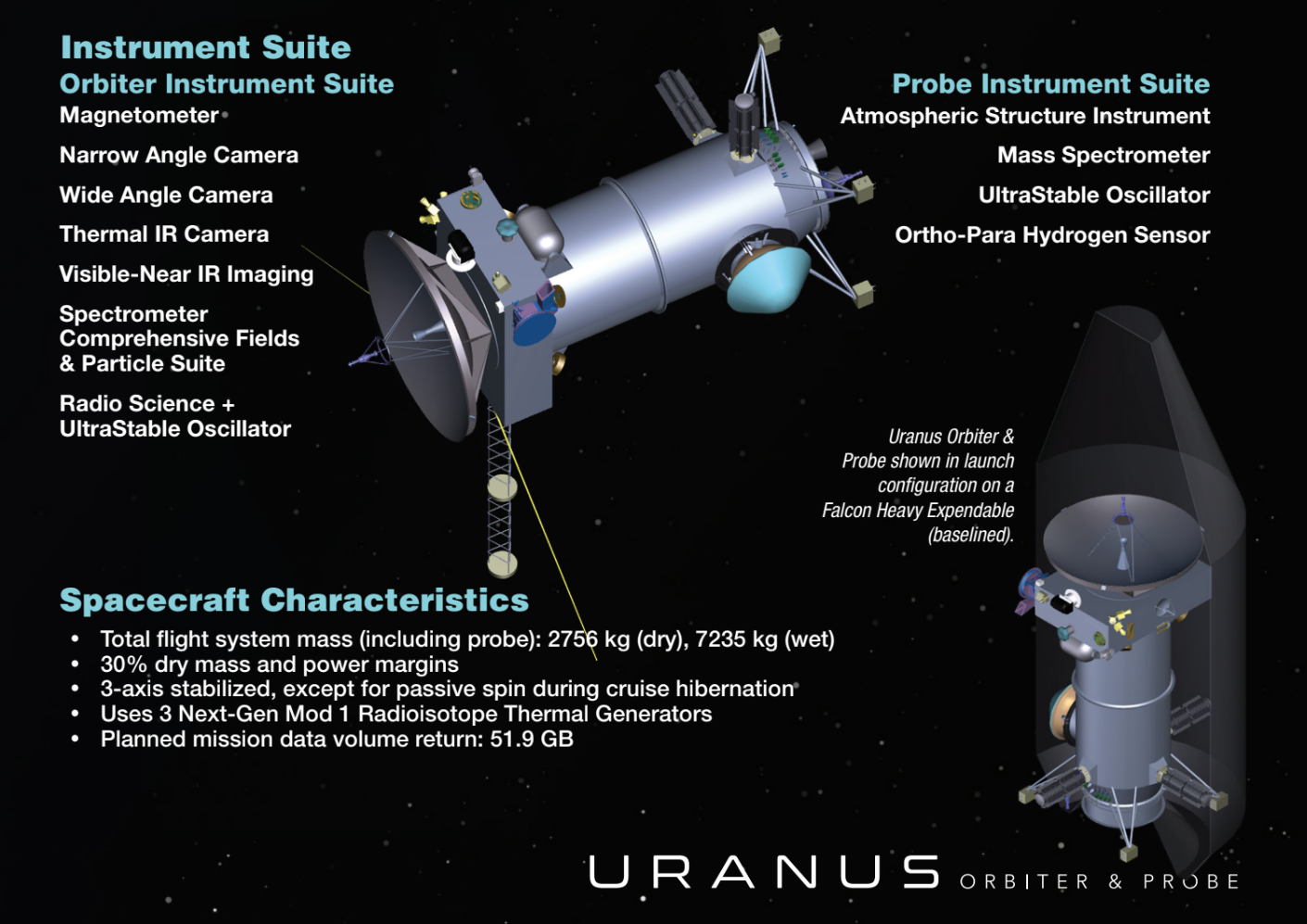
The Uranus Orbiter and Probe (UOP) is NASA's top-ranked flagship mission from the 2023–2032 Planetary Science Decadal Survey. It combines an atmospheric descent probe with a multi‑year orbital tour of Uranus and its moons. Despite funding cuts, and technical challenges related to Plutonium-238 availability, UOP remains on the latest NASA roadmap with launch planned for the early-to-mid 2030s. Once in orbit, the spacecraft will deploy a probe to plunge into Uranus’ atmosphere, measuring temperature, composition, and isotopic ratios. The orbiter itself will carry an ambitious payload that includes magnetometer, narrow-angle visible and thermal-IR imagers, NIR spectrometer, radio science, and a fields-and-particles suite – culminating in a 4.5-year mission that encompasses multiple flybys of the five major moons.
The UOP mission will go a long way toward de-risking OBO by laying the technical and logistical groundwork for long-duration operations in the Uranian system. Critically, it will also characterize the surface and environment of Oberon, confirming the geological and gravimetric stability OBO will rely on to operate with picoarcsecond angular precision for over a century.
Oberon Pathfinder
The Oberon Pathfinder would bridge the gap between the Uranus Orbiter and Probe (UOP) mission and the deployment of the Oberon Baseline Observatory. Operating from the surface of Oberon, this precursor would extend UOP’s planetary science objectives by gathering long-duration, high-resolution data on Uranus’s magnetic field, radiation environment, thermal flux, and particle dynamics as experienced on a moon that orbits far from the planet’s equator and magnetic axis. It would serve as a dedicated observer of local dust, charged particles, and micrometeorite flux – data essential for validating OBO’s expected operating environment. This surface perspective would also offer unique insight into how Oberon’s tenuous exosphere, shadowed terrain, and orbital geometry interact with solar and magnetospheric cycles – adding critical detail to UOP’s orbital dataset and helping fine-tune models of Oberon’s long-term stability as an astronomical platform.
In addition, Pathfinder would conduct a full environmental survey of Oberon’s surface, with the goal of identifying a shortlist of viable landing sites for the future observatory. The most promising site would receive a dedicated lander package, designed to simulate and stress-test key components of the eventual OBO deployment. This package would include one or more micro-rovers for terrain mapping and mobility analysis; a seismometer array for assessing crustal activity and internal structure; and a drilling and sampling system to evaluate subsurface composition, porosity, and thermal properties. Additional instrumentation – such as regolith compaction sensors, outgassing monitors, or dust-adherence studies – could be included to de-risk specific engineering concerns, especially those related to anchoring, thermal stability, or optical contamination. In essence, Oberon Pathfinder wouldn’t just characterize the moon – it would help rehearse the entire surface operations model for OBO, in the exact conditions it will someday face.
Overall Mission Timeline
By the early 2060’s, UOP would have ceased operations, and the Pathfinder mission would be largely complete
Let’s assume UOP launches in 2033, with a 13-year cruise to Uranus. That would mean a 2046 arrival, with scientific data being returned until 2051. And while this UOP data will be crucial to the overall OBO mission plan, Oberon Pathfinder could theoretically launch in the early 2040’s, while UOP is still enroute, and then use the UOP data to fine-tune the mission plan and candidate Pathfinder landing sites.
By the early 2060’s, UOP would have ceased operations, and the Pathfinder mission would be largely complete – though depending on final mission design a skeleton suite of science instruments such as the seismometer and magnetometer might still be operating. After decades of careful mission planning, refinement, technology development, and design finalization, the Oberon Baseline Observatory – the most ambitious science experiment in human history – would be ready for launch.
The mission architecture would have been finalized decades earlier, but a likely contender might look something like:
- Multiple launches as each module (science suites, reactor module, communication package, propulsion, structural elements, etc.) are sent to orbit.
- Orbital assembly – likely semi-autonomous - and attachment of all the modules to some sort of gantry-like superstructure.
- Propulsion, shielding, and other elements of the cruise phase affixed.
- OBO departs Earth and begins its journey to Uranus.
- Various gravity assist “slingshot” manoeuvres (depending on exact year of launch and planetary configuration).
- Arrival at the Uranian system, with potential aerobraking in the Uranian atmosphere.
- Insertion into orbit around Oberon.
- Modules descend one-by-one for soft touchdown on the surface.
- Fully autonomous, robotic assembly of all components into a functioning science station on the surface of Oberon
- Several months of operational checks, calibration, and then … first light
with OBO already placed in the outer reaches of the Solar System, it could provide unprecedented views of objects in the Kuiper Belt
For any new flagship telescope, first light is a big day, but while OBO’s initial image returns will be scientifically competent, they will also be … unremarkable. You see, none of the onboard instruments are designed for spectacular imagery – they are built for jaw-dropping angular precision, and then only after decades of observations are integrated. Early datasets will include calibration fields, well-studied benchmark stars, and side-by-side comparisons with Gaia and Theia targets. But after a few months, once scientists have confirmed OBO’s metrology and instrument alignment, the first wave of magic happens. After 3 months, Oberon will have traversed its 1-million-kilometer orbital baseline 14 times, and the first fully integrated observations will arrive with microarcsecond precision. These results wouldn’t necessarily be any better than what Earth-based telescopes such as Theia could achieve, but with OBO already placed in the outer reaches of the Solar System, it could already provide unprecedented views of objects in the Kuiper Belt.
But the true power of OBO lies in patience. Only after years – and then decades – of continuous data will the 6-billion-kilometer Uranus-orbital baseline begin to deliver transformational results. By year 10, we’ll be teasing out planetary masses and orbital architectures across thousands of parsecs. By year 20, subtle gravitational ripples from dark matter substructure will emerge in the proper motions of halo stars and streams. By year 30, OBO will begin reaching its full potential – measuring the subtlest gravitational ripples across our local group of galaxies, and bringing hard data to test our deepest theories of cosmology.
By the time OBO retires sometime in the 22nd century, it will have rewritten our map of the galaxy, weighed the invisible, traced the scaffolding of dark matter, revealed the architectures of thousands of planetary systems, and tested the limits of fundamental physics. But perhaps more importantly, it will have opened doors we didn’t know existed – inventing entire new fields of science, or laying foundations for theories we can’t yet imagine. OBO’s greatest gift might not even be the answers it delivers, but the questions it forces us to ask. Questions about our galaxy, our physics, and maybe even our place in something larger.
OBO’s greatest gift might not even be the answers it delivers, but the questions it forces us to ask
Generational Space Missions Don’t Come Cheap
Before we talk about the overall mission cost for the Oberon Baseline Observatory, let’s set some context. Because while OBO’s price tag would likely exceed $100 Billion dollars, we’ve spent more in the past, often for humbler aspirations and smaller payback than what OBO promises:
| Project | Est. Cost (inflation adjusted) |
|---|---|
| Apollo Program | $270 B |
| James Webb Space Telescope | $10 B |
| International Space Station | $150 B |
| Mars Sample Return Mission (proposed) | $11 B |
| Artemis Program (proposed) | $95 B |
| Manhattan Project | $30 B |
| Three Gorges Dam | $30 B |
| US Interstate Highway System | $500 B |
| Hurricane Katrina economic losses and recovery | $175 B + |
| Aircraft Carrier Strike Group (build and operate 10 years) | $45 B |
| Vietnam War | $1 T |
| Iraq and Afghanistan Wars | $2 T |
| Global Annual Advertising Spend | $1 T + |
I leave it to the reader to interpret the above list, and decide which items were (or in the case of proposed missions, will be) a worthy use of funds. My only goal is to point out that the money – and political will – to pursue big, generational projects (and sometimes they're even science projects) exists … the question is whether those resources could be harnessed for a mission like OBO.
When looking at all the zeros and commas in the OBO cost estimates, there are two critical things to keep in mind: First, it would be pioneering multiple new space technologies and solving new engineering challenges as part of the project. The future application of these technologies reaches far beyond OBO, as we’ll discuss in a moment. Aspirational though it might be, this is also an incredibly pragmatic mission. Second, we are talking about a century-scale mission: OBO will still be pushing scientific frontiers 150 years from today, and its legacy will last for centuries longer still. Amortized over 100 years, and including estimated operating costs, OBO clocks in at around $1B annually … roughly the same as the CERN Large Hadron Collider.
Oberon Baseline Observatory – Cost Breakdown
| Component | Main Cost Drivers | Low-Side | High-Side | Notes |
|---|---|---|---|---|
| Technology maturation & prototyping (2025-2060) | long-life cryo-electronics, µas metrology, km-scale laser-com, kilo-watt class space-reactor | $8 B | $12 B | spread over 35 yrs; comparable to JWST’s 20-yr tech burn-in (~$3 B) but for a far broader tech stack |
| Uranus Orbiter & Probe (UOP) | launch on SLS/ Falcon Heavy, orbiter bus, entry probe, 5 yr ops | $4 B | $5 B | NASA/ESA cost line in latest decadal study (flagship-class) |
| Oberon Pathfinder lander | cruise stage, pinpoint landing, 2 micro-rovers, drill, seismo, mags, 3 yr ops | $6 B | $8 B | roughly 3× Mars Perseverance cost because of 19 AU cruise & RTG redundancy |
| OBO flight system | 5 kW fission power-plant, 8 science modules, autonomous surface assembler, radiation / thermal shielding | $38 B | $48 B | benchmarked against ISS (US share ≈ $60 B) and JWST ($10 B), scaled for 6 launch stack, 100-yr design life, deep-space reactor |
| Launch & orbital assembly | 4–6 heavy-lift launches (Starship/SLS class), on-orbit gantry, shakedown | $5 B | $7 B | Assumes human presence on orbit to assist in assembly |
| Mission operations (surface & DSN, 80-yr tail) | ∼$40 M yr for DSN time, ops team, archiving | $2 B | $3 B | Comparable to Hubble + JWST long-tail ops |
| Programmatic reserve / over-run (≈ 75 %) | $39 B | $51 B | Given the multi-domain ambition of this program, factor in elevated overrun costs | |
| All-in range | $100 B | $135 B |
Total cost in an optimized “all goes well” scenario would therefore be in the range of $100 Billion, while a more realistic estimate that includes a few inevitable "high side" costs might creep toward $135 Billion. And if we already consider the Uranus Orbiter and Probe to be fully funded as its own standalone mission, then the all-in cost for OBO drops by $5 Billion.
OBO will still be pushing scientific frontiers 150 years from today
Engineering POCs and Mission Payback
So far, we’ve talked about the Return on Investment for OBO strictly in terms of pure scientific value – the epoch-shaping breakthroughs it would inevitably spark. But there is another, arguably more important payback if humans have any serious plans to become a spacefaring species: OBO will serve as an engineering crucible for dozens of 22nd century space systems and technologies.
Let’s be honest: if you’ve read this far, it’s because you’re a bit of a science nerd (and probably more than a bit of one). But for the vast majority of people, the really compelling space science doesn’t involve astrometric observations or dark matter characterization or long-baseline radio arrays … it involves human space flight. We are a species of explorers, and so the stories that really hit us in the gut are the ones where people climb into starships and spread our civilization throughout the stars.
But let’s be honest again: those stories will never happen unless we scale up our space engineering. Way up. But let’s leave the concept of Generation Ships and lightyear-scale journeys aside for now. Let’s anchor this part of the conversation around the more modest idea of sending a couple dozen humans to establish a permanent base on Jupiter’s moon Callisto. With that stage set, let’s talk about the engineering challenges humans will have to solve to make OBO – an unmanned science outpost operating for a century – a reality.
Orbital assembly of large deep-space craft
Creating a reliable, long-duration platform at this scale would pose engineering challenges that make the International Space Station look like a Lego prototype
The most likely mission architecture for OBO involves multiple heavy-lift launches delivering modules to low Earth orbit, where they are assembled into a single interplanetary cruise vessel – potentially one capable of aerobraking into the Uranian system. Creating a reliable, long-duration platform at this scale would pose engineering challenges that make the International Space Station look like a Lego prototype.
The OBO cruise stage must function as a fully autonomous interplanetary ship, built to withstand decades of deep-space radiation, dust, sustained low-thrust propulsion, and – depending on mission design – high-velocity aerothermal loads on arrival. That demands robotic assembly with millimeter-scale precision, structural integration rated for interplanetary G-loads, and complete validation with minimal human intervention. In that sense, OBO becomes a full-scale rehearsal for future crewed interplanetary missions, deep-space manufacturing platforms, and even early interstellar vehicles. If we can’t get OBO right – after decades of planning and a hundred billion dollars – then we are tacitly admitting that Earth, plus perhaps the Moon, will remain the limits of our frontier.
Autonomous landing and robotic assembly of mission packages
Once every module lands softly and accurately at its pre-designated site on Oberon, the next challenge begins. The OBO surface station wouldn’t be a single monolithic lander – it would be a distributed, multi-module observatory that must self-assemble in one of the coldest, most remote environments in the solar system. That means autonomous unpacking, alignment, integration, trenching, burial, thermal anchoring, cabling, and ultimately commissioning – all executed by robotic systems without human hands and with a five-hour round-trip delay any time humans do need to intervene.
Some components may need to be buried – fully or partially – for shielding. Others may be isolated some distance away from the other modules. Still others, like the VLBI node and laser communications package, will need micron-scale alignment precision after deployment. Redundancy, cross-checking, self-aware assembly algorithms, and automated fault recovery aren’t luxuries – they are foundational requirements.
But here’s the larger payoff: the ability to pull this off would mark a turning point for space infrastructure. Long before humans arrive at Mars, Titan, or Callisto, we would want “almost occupation ready” infrastructure in place on the surface. That means water has been collected (and some of it cracked into oxygen and hydrogen), habitats are assembled and have been pressure-tested, reactors are powered-up and ready, and comm systems active. All of this is only possible if robotic precursors arrived ahead of time – landers, miners, fabricators, and engineers – then beamed an “all good” message to the arriving crew. OBO will be designed to prove many of these exact things: land softly, self-assemble, and work for decades without a reset switch.
OBO will be designed to prove many of these exact things: land softly, self-assemble, and work for decades without a reset switch
Autonomous surface operations with century-scale reliability
Most spacecraft are designed for a few years of operation. Some, like Voyager or the Mars rovers, have pushed that into the decades. But OBO is something else entirely: it must function for a full century, on a frozen moon 3 billion kilometers from Earth, without maintenance, resupply, or intervention. This is more than a question of robust engineering – it is a test of whether humans can design machines that endure on deep time scales, quietly working long after their creators are gone.
This means building systems that are self-monitoring, self-adapting, self-healing, and fail-operational. Every core function – from thermal regulation to metrology alignment to internal power routing – must be protected by layered redundancy, but also capable of diagnosing faults, rerouting around failures, and continuing useful work even under degraded conditions. Radiation shielding must last decades without embrittlement. Lubricants must resist ablation in a hard vacuum. Software must be remotely updatable, but also brick-proof, with rollback mechanisms that can’t be compromised by a bad uplink or a half-flashed patch. Overseeing everything, sophisticated AI will self-triage, perform predictive diagnostics, and assess options when incidents occur or equipment degrades. Operating in the outer reaches of the solar system, OBO will have to be able to think its own way out of trouble in all but the most extreme scenarios … and even in those cases it will need the ability to stabilize itself, send diagnostic data home, and then follow instructions.
OBO’s century-scale resilience may seem excessive for a telescope, but these are the exact capabilities we’ll need if we ever hope to launch generation ships to nearby stars, or automated missions to seed the outer solar system. An early base on Callisto might only need to last a few decades, with human crews rotating in and out. But even then, no crew wants to take a 4-year journey to a base that just barely meets its design objectives. Century-scale operation should be our default design requirement, and OBO will prove out the technologies that get us there.
Kilowatt-scale long-duration fission reactors
a fission reactor that simply outlives its builders: launched hot, sealed tight, and engineered to endure
When planning a century-class mission like OBO, energy becomes the defining constraint. You either need a way to replace fuel during the mission, or a way to never need to. And in the deep outer Solar System – with no sunlight and no ability to service the system in person – the only viable solutions are high-efficiency, long-life reactors or radical new methods of robotic refueling.
The simpler, more realistic path is to design the core for 100+ years of service. That likely means using low-burnup, high-enrichment fuels such as uranium nitride (UN) or uranium molybdenum (U-Mo), cooled by inert gases (e.g., helium–xenon) or liquid metals (e.g., NaK) that minimize corrosion. A passively regulated core with no moving control rods (e.g. using thermal feedback for reactivity control) reduces wear and lowers failure modes. Even so, the system must also resist fuel swelling, embrittlement, and radiation damage over unprecedented durations. These are the kinds of materials problems OBO would help de-risk for every future deep-space mission.
The alternative path – robotic refuelling – sounds far-fetched today, but will eventually be essential for permanent infrastructure in the outer Solar System. That might involve standardized fuel cassettes, robotic manipulators capable of hot-swapping shielding and core segments, and an orbital or surface depot with enough autonomous fuel handling precision to perform nuclear maintenance with no human present. As the OBO mission design takes shape, we might decide to test limited forms of this … perhaps not full refueling, but automated system isolation, switching to redundant power channels, or repositioning shielding elements after decades of thermal drift.
There are dozens of exotic power sources on the drawing board, but for now the gold standard remains a fission reactor that simply outlives its builders: launched hot, sealed tight, and engineered to endure. If OBO can prove that a fission core can power kilowatt-scale systems for a hundred years without intervention, then the same architecture could someday be scaled up for interstellar probes, generation ships, or permanent bases on moons like Callisto.
Deep-space laser communications
Over the course of its century-long mission, OBO’s various telescopes and instruments might collect more than 10 Petabytes of data
Over the course of its century-long mission, OBO’s various telescopes and instruments might collect more than 10 Petabytes of data. Even with a data compression factor of 2.5:1, that leaves 4 Petabytes of data to transmit from Oberon’s surface to Earth. If we tried to rely on Ka-band radio (today’s standard for deep-space communication) to send that volume of data, it would take about 10,000 years. It’s simple physics: as transmission distance increases, maximum achievable bandwidth drops, and Uranus is located almost 3 billion kilometres from Earth.
The only realistic option is to use laser-based optical communication. Laser comms offer a huge leap in capability. With tight beam coherence, higher carrier frequencies, and smaller receiver apertures, optical systems can deliver orders of magnitude more bandwidth per watt than legacy deep-space radio links. NASA's LCRD and Psyche DSOC are already demonstrating these capabilities in cis-lunar and interplanetary space. For OBO, a laser-based downlink system (at a minimum, and potentially laser-based uplink as well) would enable high-speed data returns that not only keep pace with ongoing data generation in real-time, but offer enough additional bandwidth to “catch up” after periodic Earth-line-of-sight blackouts caused by Oberon’s orbital geometry – all while using far less power than a comparable RF transmitter.
But laser comms present some hard challenges: they require extremely precise pointing, weather-independent (or space-based) Earth receivers, and robust error correction that can tolerate low-photon-count transmissions over billions of kilometers. OBO would be the first platform to test these systems over century-class durations and interplanetary distances beyond Saturn. In doing so, it would not just provide a data link for the most ambitious observatory ever contemplated – it would pave the way for deep-space relays, outer-planet networks, and high-bandwidth support for future outposts on moons like Callisto, or even outbound interstellar probes.
Precision Metrology and Autonomous Alignment
Deep-space laser communications are one example of a system that will rely on micron-scale alignment, but this capability will be equally important to the astrometry suite and the VLBI node. This precision and alignment stability will need to be maintained across seasons and thermal cycles for 100 years. OBO’s instrumentation will also need to be able to monitor itself and detect alignment anomalies caused by nearby micrometeorite strikes, thermal stresses, or age-related wear and deformation, retrying and self-correcting in response … all without human oversight or input.
These capabilities, once proved out by OBO, will serve future spacecraft, antenna arrays, and construction platforms throughout the Solar System. The ability to measure, compare, and adjust – at micron scale – across long baselines with no human in the loop will be an essential capability as we scale up our spacefaring ambitions.
Cryogenic Surface Laboratory
Because Oberon's ambient surface temperature (60 - 80K) is lower than that of several high-Tc superconductors, OBO presents a unique opportunity to test in-situ superconductivity for various systems such as:
- Superconducting power bus, proving loss-free power routing over long distances – for example when locating reactor-based power modules away from sensitive equipment.
- Superconducting MKID Infrared focal plane, either as an upgrade to the proposed thermal mapper instrument, or a new standalone experiment.
- Quantum-limit microwave amplifier for Ka-band deep space communication.
- Maglev cryomotor reaction wheels would minimize friction losses and eliminate the need for lubricants, enhancing reliability.
These are admittedly speculative opportunities, but developing and deploying even one of them at century-scale would be a massive enabler of future space technology.
Conclusion
it will slowly, over the course of decades, start unravelling the secrets of the universe, outlasting every single one of its creators, and then persisting through another generation of human scientists, and another, and another
When I first started researching this topic, I had little idea how deep the rabbithole would go. But as I read more, and thought more, and kept refining the mission plan, I gained a deep appreciation for just how elegant the Oberon Baseline Observatory is as a science platform. From the perfection of Oberon’s 1-million-kilometer baseline oriented orthogonally to Uranus’ 6-billion kilometer baseline, to the synergies between OBO’s science packages, to the fact many of the hardest engineering challenges are actually human migration POCs in disguise.
I won’t claim to have the astrophysics or cosmology chops to truly grasp the details of the science OBO might unlock (though I learned quite a bit throughout this process!) I also won’t claim to have the aerospace engineering chops to truly grasp the magnitude of what I’m proposing here.
But here’s what I do understand: the Oberon Baseline Observatory has an incredibly compelling storyline. It’s a mission that will require 4 decades of patience and commitment before a single piece of optical glass even leaves the ground. Then, after surmounting some of humanity’s toughest engineering challenges, it will slowly, over the course of decades, start unravelling the secrets of the universe, outlasting every single one of its creators, and then persisting through another generation of human scientists, and another, and another. The power of the data it collects would keep growing, quietly, inexorably, reshaping our very concept of the universe.
Centuries from now it would be remembered as a testament to our reverence for knowledge … an enduring symbol long after the reactor splits its last atom and the mirrors collect their last photon, much as the Voyager probes will go on carrying their golden records out into the void – silent and enduring.
And maybe, in building something that endures, we’ll remind ourselves of our own place in the universe ... and of our role as stewards of every human achievement that has come before.