Big Plans for Uranus - Part 1
Why Uranus – the "punchline planet" – is the most fascinating place in the solar system, and why we should make it the prime target for a big, generational series of space missions.
Part 1
The best thing about running your own blog is that you can write about literally anything that tugs at your interest. Lately, I’ve been researching Uranus, an Ice Giant planet 3 billion kilometers from the sun, and its system of 5 main moons. And believe me when I tell you this system deserves way, way more attention than it receives from the general public – I mean aside from juvenile jokes like the one in this blog title.
7 probes have flown to, or through, the Jovian system to investigate. A further 4 probes have investigated Saturn. But Uranus has had exactly one human-launched visitor: Voyager 2.
When most people (or at least those who think about interplanetary space at all) think about exciting targets of exploration and research, Jupiter and Saturn get all the love. In the Jovian system, there’s the hypothesized deep under-ice ocean of Europa, heated by tidal flexing where alien life unlike anything we’ve ever seen just might be lurking. There’s the hellscape of Io, with volcanoes that spew molten sulfur into space, and radiation levels that would kill a person in minutes. There’s the calm and solid Callisto – the only major moon of Jupiter with surface conditions that invite human colonisation. In the Saturnian system, there’s Titan, with a thick (though cold) methane atmosphere and active weather and geological processes more similar to Earth than anywhere else in the solar system. There’s Enceladus, another ice-covered deep ocean world brimming with potential. And then there are those gorgeous and fascinating rings.
It only makes sense that a total of 7 probes have flown to, or through, the Jovian system to investigate. A further 4 probes have investigated Saturn. But Uranus has had exactly one human-launched visitor: Voyager 2, which blazed through the system in 1986 at a speed of 15km/s as part of its “grand tour” of the outer planets. Racing past at that speed, it could only capture snapshots of parts of each major moon – imaging less than 50% of the surface of Miranda, and 20-30% of the other 4 moons. But it was enough to give a tantalizing hint at what might be possible if humans make Uranus a major focus of science in the coming century.
The 98 degree axial tilt
Perhaps the strangest thing about Uranus is its 98-degree axial tilt – it basically lies on its side as it orbits the sun. Scientists have a few theories about how this came to be, but the leading contender involves multiple perfectly aligned impacts from smaller Mars-sized bodies several billion years ago. These impacts would have destroyed any existing system of moons, then created a new accretion disk tilted at the same 98 degrees, which then coalesced into the satellites we know today. Considering this violent history, the major moons (Miranda, Ariel, Umbriel, Titania, and Oberon) form a remarkably orderly system: all are tidally locked to Uranus with almost circular orbits and very little gravitational perturbation (spoiler alert, in Part 2 of this blog entry I’ll talk more about what a huge win this is for a science outpost).

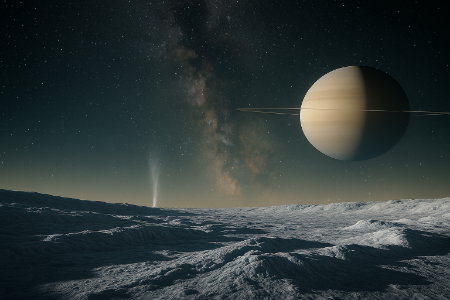
What would a “day” on Titania – Uranus’ largest moon – look like? Well that really depends on the season, and where on the surface you’re standing. Let’s say you’re standing on the north pole and it’s summer solstice. Uranus would appear as a ghostly aquamarine half-sphere low on the horizon, and it would stay in the exact same spot. Forever. The sun appears as a small white dot – 1/20th the size it appears from Earth – almost directly overhead. As Titania orbits Uranus over the course of about 9 earth-days, the sun would wobble in slow circles directly overhead. Over the next 21 earth-years, those circles would slowly expand until the sun is hugging the horizon as it spins 360 degrees around you, the viewer.
Twenty one years after solstice, the Uranian system reaches equinox. Viewed from the north pole of Titania, Uranus would still be in the exact same spot in the sky, but it would now pass through a full cycle of phases every 9 days: full Uranus, waning gibbous, waning crescent, new phase, waxing crescent, waxing gibbous, and then full again. A few of these equinox phases might feature an eclipse that hides the sun for several hours at a time.
That’s life at the poles of Uranus’ major moons: 42 years of sunlight followed by 42 years of darkness.
After equinox, as the sun spirals below the horizon, a person standing at the north pole would experience 42 consecutive years of complete darkness. Not until Uranus completes half an orbit around the sun, and is on the other side of the solar system, would the sun start spiralling back up into the sky. That’s life at the poles of Uranus’ major moons: 42 years of sunlight followed by 42 years of darkness. Perhaps some future human colony would build two bases: one at the south pole of Titania or Oberon, and one at the north pole, and then migrate back and forth every 42 years to stay in permanent (but dim) sunlight. Humans would spend an entire lifetime experiencing a single year of a slow, deliberate world.

Ocean worlds?
Fifty years ago, most scientists assumed Earth was the only body in the solar system with any significant amount of liquid water. Then, in July 1979, as Voyager 2 sped past Jupiter, it returned images of the moon Europa that showed evidence of liquid water below the solid ice surface. In the years since, additional probes and earth-based telescopes have increased that count to a dozen potential water worlds: Europa, Ganymede, Callisto, Enceladus, Titan, Mimas, Triton, Pluto, Ceres, Ariel, Titania, Oberon, and potentially even more.
In some cases, scientists have good theories as to how these bodies have retained enough interior heat to sustain liquid subsurface oceans. In other cases, the mechanisms remain a mystery, and the moons of the Uranian system fall into the latter category. Somehow these moons – three billion kilometers from the sun and orbiting a planet with a relatively weak magnetic field – appear to be generating enough energy to stay toasty inside. How they are doing it will remain a mystery until we send a mission to study the system in better detail.
Uranus is exciting because of what it might tell us about galactic mechanics, dark matter, cosmology, and everything else.
And there is a mission planned. The Uranus Orbiter and Probe (UOP) mission will send a spacecraft to orbit the planet and its major moons, and then drop a probe into Uranus’ atmosphere to sample conditions as it descends through increasing pressures toward its eventual death. It will unravel the mysteries the strange and extreme dynamics of Uranus’ atmosphere, as well as mapping the moons and providing solid evidence of their composition. UOP (should it ever fly – the latest NASA budget puts it in doubt) will give us our first up-close look at an Ice Giant, one of the more common types of exoplanets likely to be out there in the universe.
But to me, the real reason to go to Uranus isn’t just to study it. It’s that the Uranian system might be the single-best platform in the solar system for studying the rest of the universe. Its stillness, its geometry, its orbital period and distance from the Sun – all create a uniquely quiet and stable vantage point. Jupiter is exciting for what it might tell us about Jupiter. Same with Saturn. But Uranus? Uranus is exciting because of what it might tell us about galactic mechanics, dark matter, cosmology, and everything else.
And in my next blog entry I’ll explain exactly what I mean.