Big Plans for Uranus - Part 2
Why building a robotic observatory on the surface of Uranus' moon Oberon would unlock scientific discoveries no other mission can.
Part 2
In part 1 of this series, I talked about the Uranian system from a romantic perspective – the clockwork elegance of their sideways dance around the Sun, and how truly strange it would be for humans to stand on those alien moons. In part 2, it’s time for some hard science, because a mission to Oberon – an expensive and audacious one to be sure, but one that’s feasible even with today’s technology – would be a civilizational leap that redefines our entire understanding of the cosmos.
Buckle up. This gets pretty wild.
Let’s start by talking about a truly remarkable instrument: The Gaia Space Observatory, launched by the European Space Agency mission in 2013 to create the most precise 3D map of our galaxy ever assembled. Gaia measures the positions, distances, motions, and brightnesses of over 2 billion stars, using parallax and proper motion analysis to chart the Milky Way with unprecedented accuracy. Gaia has revolutionized our understanding of stellar evolution, galactic structure, and the gravitational dynamics of nearby stars – but its 2 AU (astronomic unit) baseline limits its accuracy. With an angular precision of 10 microarcseconds (μas) at best, Gaia reaches to maybe 10,000 light years, and that’s only for relatively bright stars.
What if we could place that telescope on a cold, dark, stable platform with a parallax baseline of six billion kilometers?
Hold your finger in front of your face and close one eye. If you switch eyes, your finger appears to jump to a different position against the background. That’s parallax. Now imagine your finger is a relatively nearby star. The potted plant across the room is some incredibly distant galaxy. Your left eye is Earth in December when it’s on one side of the Sun, and your right eye is Earth in June after it’s travelled halfway around its orbit to the other side of the Sun. That’s parallax the way it’s used by Gaia to map star positions in our neighbourhood of the Milky Way Galaxy.
As trivial as this example sounds, it’s an incredibly effective “cheat” that allows us to take advantage of the fact Earth is always 300 million kilometers (two AUs) away from where it was six months ago. We’ve learned a lot about the cosmos this way. But what if we could build a space telescope far away from the light-scattering and gravity-perturbing influences of the inner solar system? What if we could place that telescope on a cold, dark, stable platform with a parallax baseline of six billion kilometers, roughly twenty times with parallax available to Gaia? What if we built a flagship science mission on Uranus’ moon Oberon and named it the Oberon Baseline Observatory, or OBO for short?
OBO would change everything
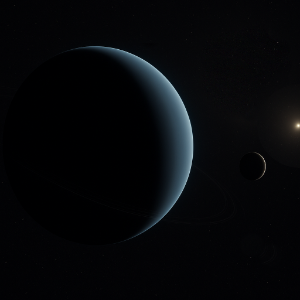
Let’s revisit the surface of Oberon, because almost everything about it is ideal for a mission like OBO. Nature built the perfect platform and is waiting patiently for us to realize it.
- Dark and quiet: Uranus orbits the Sun at a distance of almost 3 billion kilometers, receiving just 0.3% of the sunlight Earth does. From Oberon, the Sun appears as a cold, white pinprick. There’s no atmosphere to scatter light. No dust storms. No satellites or stray glints. Instruments here can stare into the cosmos with perfect clarity in every direction, unblinking and undisturbed.
- Cryogenic cold: In full sunlight, Oberon barely touches –198°C; in shadow, temperatures drop to –233°C. The surface is a natural deep-freeze, ideal for infrared and ultraviolet detectors. And with a 14-day orbit, thermal cycles are long and slow, reducing mechanical stress and extending calibration stability over decades.
- Low gravity: At just 3.5% of Earth gravity, Oberon is light-footed. Structures are easier to support. Instruments can be reoriented or repositioned with less torque and smaller motors. This gravity is gentle enough to enable precise deployments, but strong enough to anchor a stable platform.
- Geological stillness: Oberon appears to be geologically inert – no quakes, no ice geysers, no shifting terrain. Combine that with its low-eccentricity orbit and the general orderliness of the Uranian system, and you get a wonderfully stable foundation for instruments that need to remain motionless for years at a time. That’s pure gold for a long-baseline mission like OBO.
- Fewer meteorites: The outer solar system is a quiet place. Oberon likely experiences 10 to 100 times fewer micrometeoroid impacts than bodies in the inner solar system. Fewer strikes mean less risk to hardware, and fewer tremors disrupting sensitive readings.
- Low radiation: Uranus has a relatively weak magnetosphere, and Oberon orbits near its outer edge – often dipping into the solar wind. But at this distance from the Sun, the solar wind is thin and slow. Radiation exposure here is minimal, especially compared to Jupiter. That means lighter equipment, less shielding, and more design flexibility.
- Built-in shielding: Gaia floats through space with no protection but what it carries. OBO could do better. Sensitive electronics could be buried beneath Oberon’s regolith, using the ice itself as a radiation and thermal buffer. Nature becomes the shield, saving mass and cost.
- Orbital geometry and sightlines: An observatory placed near Oberon’s equator would see a full sweep of the sky every 14 Earth days. Place it on the side opposite Uranus, and you’d have a permanently unobstructed field of view. And with predictable geometry, communication with Earth is easy to calculate.
- And then there’s the baseline: Earth’s orbit gives us a parallax baseline of 300 million kilometers. Uranus stretches that to almost 6 billion kilometers — a staggering 38 AU. A baseline this massive opens entirely new windows into stellar motion, dark matter dynamics, and ultra-long-arc gravitational effects. The science emerging from a platform like this would be nothing short of transformational.
- And then there’s the bonus baseline: Uranus orbits the Sun at a distance of around 3 billion kilometers, but Oberon also orbits Uranus at a distance of half-a-million kilometers. What this means in practice is that Oberon orbit provides a million-kilometer parallax baseline roughly every seven days. Better still, because of the tilted nature of the Uranian system, this baseline is orthogonal to the large, long-period baseline of Uranus. This short-period parallax would start providing science returns within weeks of first light (rather than waiting decades for the Uranus-scale science to unfold) for relatively nearby objects. The steady heartbeat of this smaller parallax would also act as a calibration mechanism for OBO’s astrometry suite.
Just a single optical telescope located on the surface of Oberon would be a game-changer, but with a platform this perfect, let’s design a mission payload that reaches for the stars.
A Game-Changing Science Payload
Core to the OBO mission is an Astrometry Suite, designed to take advantage of Oberon’s 38 AU parallax baseline to map star positions and proper motion in exquisite, sub-mircoacrsecond detail. Two instruments – a visible light and near-infrared telescope in the 4 meter size class, and a 30-50 cm class ultraviolet telescope optimized for 135-300 nm wavelengths (FUV + NUV) – would work in tandem to track stellar positions and motions across complementary wavelengths. The visible and near-infrared channel would target the majority of Milky Way stars (red dwarfs, solar analogs, and cool giants) while the ultraviolet telescope would specialize in hotter, younger stars, white dwarfs, and compact remnants. Together, they would deliver overlapping astrometric baselines with cross-spectral calibration, improving precision while enabling studies of stellar populations often invisible to missions like Gaia.

Sidebar: Are Three Astrometry Scopes Better Than One?
It is worth digressing briefly to talk about other options besides a single massive 4m primary mirror for the astrometry suite. A four meter mirror – while it would be helpful in terms of light-gathering and diffraction limitations – would also be very heavy and would pose immense metrology challenges, even in Oberon's weak gravity. It would also represent a single point of failure: if the 4m primary is damaged at any point, the astrometry mission effectively ends.
Another option might be to deploy an array of three 2.5m-class telescopes, linked in an interferometric array. This could improve OBO's performance by yet another order of magnitude while simultaneously de-risking the mission through redundancy (a single component failure would reduce precision, but the mission goes on). This array would also leverage various precision-timing and metrology components we're already bringing to Oberon as part of the VLBI node and communications module.
I won't go into further detail in this blog series (which already runs over 10,000 words), but it's an idea worth unpacking in the future.
Beyond the Astrometry Suite
A key package supporting the Astrometry Suite would be a Wide-Field Suite with three instruments:
- A Wide-Field Imager in the 1 – 1.5 m class covering visual wavelengths. This device would play a key role in spotting emergent phenomena and transient events, identifying targets for further study with the astrometry suite. A wide-field device could also play a role in early detection and planetary defense, spotting Earth-bound objects from the outer reaches of the solar system.
- A Thermal Mapper would augment the Wide-Field Imager by covering far-infrared frequencies (though at lower resolution) since dim, distant bodies are often more easily detected in infrared bands.
- Finally, a Microlensing Detector would be an immensely powerful tool if located on a cold, dark moon in the outer solar system. Microlensing occurs when a massive object – like a star, planet, or black hole – passes between the observer and a more distant background star, briefly bending and magnifying its light due to gravity. A slight, temporary brightening can reveal the presence of otherwise invisible objects. This would be another 1 – 1.5 m wide-field instrument, but it would spend its time staring patiently at dense star fields for days, weeks, or years at a time.
A wide-field device could also play a role in early detection and planetary defense, spotting Earth-bound objects from the outer reaches of the solar system.
The next package is the Heliophysics Suite. This one isn’t about studying faraway stars, but instead it aims to better characterize our solar backyard. It would include a plasma analyzer to measure ion and electron densities and velocities, a magnetometer to track fluctuations in the interplanetary magnetic field, and a dust impact sensor to characterize micrometeoroid populations at Uranus' distance. Together, these instruments would provide crucial data on how the solar wind evolves over billions of kilometers, how the heliosphere responds to solar activity, and how energetic particles interact with the boundary regions near the edge of the solar system (as well as Uranus’ strange, tilted magnetosphere).
Finally, we come to the most scientifically ambitious part of the entire OBO mission: the VLBI (Very Long Baseline Interferometry) Node. Interferometry relies on ultra-precise synchronization in both space and time to simulate a much larger telescope – a technique known as creating a synthetic aperture. Instead of building a single 50-kilometer-wide dish, we can combine the signals from multiple smaller telescopes spread over that distance, aligning their wavefronts with nanosecond precision. The result is the resolving power of a telescope as large as the separation between the antennas – without needing to construct one physically.
Theoretically, interferometry can be applied to any wavelength of energy, from radio to cosmic rays, but in practical terms – and especially when contemplating a baseline distance of 3 billion kilometers – we are limited to radio and microwave frequencies such as S-band, X-band, or Ka-band. Even at these relatively “forgiving” frequencies, achieving and sustaining wavefront alignment over a 3-billion-kilometer baseline would an engineering challenge like no other. Fortunately, OBO’s core astrometry mission already demands an atomic clock, tight inertial control, and exquisite pointing accuracy. Enabling VLBI might not be trivial, but we wouldn’t have to reinvent the whole mission. Building for VLBI would just be the cherry on top.
Mission Infrastructure
Of course, all these scientific instruments will require supporting infrastructure. Power and communications are the primary concerns, and both are significantly more challenging when you’re located 3 billion kilometers away from the Earth and Sun.
For power, solar panels simply aren’t feasible out where insolation runs at 0.3% of what we see here on Earth. The go-to technology for deep space missions are RTGs (Radioisotope Thermal Generators) – they’re simple, reliable, and good for decades – but OBO isn’t your typical mission. The hardware we’re proposing would require several kilowatts of power, especially when data is being transmitted back to Earth. And OBO isn’t intended to run for decades … it will be designed to last for at least one full orbit of Uranus: 84 years. It will be our first century-scale space mission. To meet these demands, a small, robust 5-8 kW Nuclear Fission Reactor will be required.
Designing a 100-year autonomous fission reactor isn’t trivial. But it’s not science fiction either. Submarine reactors already run for decades. On Oberon, with deep cold and zero interference, we can build something simpler, smaller, and longer-lived. Installed on the surface of Oberon, a small reactor could easily radiate its heat away to the cold void of space or sink it into the frosty regolith.
a platform like OBO will generate so much data, we would need sustained throughput of 20 or 30 Mbps
Comms are probably the bigger reach for OBO. Conventional deep space transmission takes place in the Ka radio band, but Uranus is so far from Earth, we would require a 2-3m radio dish blasting out 100 watts of power to reach a bandwidth of 0.15 Mbps. But a platform like OBO will generate so much data, we would need sustained throughput of 20 or 30 Mbps. So while Ka band communication would certainly play its part in a hybrid communication design, the backbone of the data downlink would have to be a space-based laser transmitter. This choice brings its own complications – primarily the need for ultra-precise alignment and station-keeping – but these are challenges that already need to be solved as part of the VLBI node. We’re in good shape here.
You might have noticed what isn’t included in the OBO manifest: there are no Uranus-facing science packages intended to study the planetary system itself. While it’s always tempting to add “just one more” instrument to the mission payload, designing for telescopes or sensors aimed at Uranus means the entire OBO station would have to be located at a point on Oberon where Uranus is in view. That would add light scattering, potential radio-magnetic interference, and obscured sections of sky. The core astrometrical mission is too important to dilute. Studying Uranus itself will have to come later, and in fact a great deal of this study would have been done via precursor missions before a single component of OBO launches.
Humanity’s fist century-scale mission
if every single vantage point prior to year 85 is unique, this mission should aim for an 84-year lifespan
If Uranus, with it’s 6 billion km baseline is good, why not go even further? Neptune offers a 9 billion km baseline. Pluto offers 12 billion. Aside from all the other advantages of the Uranian system, it all comes down to orbital period. Uranus takes 84 years to orbit the Sun. That means it takes 42 years to traverse the full width of the parallax baseline, and the whole point of the astrometry suite is to study the same objects from two spots 6 billion kilometers apart. 84 years is human lifespan territory. 42 years is professional lifespan territory – a grad student writing a thesis in year 1 has a shot at seeing the data come back before they retire. Neptune? It takes 165 years to orbit the Sun. Pluto takes 248.
But an 84-year orbit is still a really long time, and if every single vantage point prior to year 85 is unique, this mission should aim for an 84-year lifespan at an absolute minimum. Ideally, OBO would still be in good health and continuing to probe the heavens a full century after first light. Planning for that kind of mission life comes with big risks, but even bigger rewards.
Currently, Voyager 1 is humanity’s longest-serving space mission. It has been drifting away from the Sun for almost 50 years. At this point, 4 of the original 11 science instruments still operate, as mission controllers shut them down one by one to conserve dwindling power supplies. The Hubble Space Telescope has been in operation for around 35 years, and the ISS for 25, but both have had the benefit of servicing missions and human presence in low Earth orbit. Extending these longevity successes to OBO – a sophisticated semi-autonomous observatory consuming 4-5kW for over a century – would require us to cross a whole series of space engineering thresholds. None of these are impossible individually, but coordinating them all as part of a complex mission would be a civilizational achievement unlike anything humans have ever attempted.

For starters, our design must assume that no servicing mission – human or robotic – would ever visit OBO. Every instrument and every system must be built with sufficient hardening, fault-tolerance, redundancy, autonomy, and remote diagnostic and recovery capability to last a lifetime. The engineering challenges touch nearly every system:
- Autonomous Operations: Even though OBO would be able to “phone home” when novel situations arise, the sheer distance creates a 5-hour lag for the signal to complete a round trip. OBO will need robust situational awareness, sufficient processing power for local-decision-making, and likely some degree of roboticized maintenance.
- Fission Reactor: To push reliability past the 100-year mark, the reactor design should prioritize simplicity with a minimum of moving parts. While sinking heat into the icy regolith is one option for thermal management, if this approach involves complex systems for fluid circulation, etc. then simple passive radiators – while potentially larger and heavier – may prove to be more reliable as long as the design is resilient to micrometeorite impacts. Unattended operation spanning 100 years will require a design that either requires no refuelling, or is self-refuelling.
- Thermal Management: Equipment will need to be kept within thermal operating parameters – in some cases (e.g. atomics clocks and some other electronics) active heating will be required, and in other cases (e.g. IR sensors) cryogenic cold must be carefully maintained by avoiding things like radiators becoming fouled by dust. Even for basic structural components, century-scale reliability demands careful thermal control to avoid things like thermal warping and thermal-cycling-induced stress.
- Material Stability and Degradation Resistance: Meeting the challenge of a 100-year mission will require careful consideration of every single material used in OBO’s design. Will materials become brittle after many decades of exposure to radiation? Will critical lubricants degrade or ablate to space in the cold, hard vacuum? Can self-healing materials be used?
- Mechanical and Optical Components: As much as possible, mechanisms should be designed to minimize movement and parts count. Items such as servos, solenoids, shutters, reaction wheels, etc. should be “overbuilt” to ensure longevity.
- Electronics and Data Storage: In the cold void of space, even a single cosmic ray particle can cause “bit flip” corruption of storage and electronics. Meeting this challenge will require a mix of technologies. Radiation-hardened electronics and error-correcting algorithms are table stakes. In addition, redundant systems with robust restart, reset, and recovery will help manage downtime and risk of early failure. OBO will also need remote diagnostic and software upgrade capability, to allow humans to step in when needed for error fixes or to enhance the science software. Finally, a mix of storage media would be prudent. Long-term WORM (Write Once, Read Many) storage could be used to create an onsite archive of raw, uncompressed science data, ensuring that even if the CPU or reactor dies in year 73, the galaxy-scale astrometry data is still there, waiting.
- Pointing and Equipment Calibration: The low-gravity environment of Oberon is advantageous in many ways (easier structural engineering, less torque required for moving parts) but it also presents challenges around motion propagation. Nearby micrometeor impacts or even something as benign as OBO spinning up a reaction wheel could disturb the sensitive alignment. Maintaining precise alignment will require retry logic, drift compensation algorithms, and regular calibration against known celestial targets.
- Systems burial or partial burial: For any systems that do not need sky visibility, burying under one or two meters of regolith would be a simple, effective, zero-mass way to protect against radiation, thermal cycling, and meteorites. Even trenching provides some modest protection.
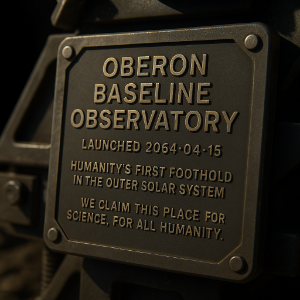
It all sounds incredibly ambitious because it is. But the scientific payoff would be unlike anything we’ve ever contemplated before. In Part 3 of this series, we’ll dive deep into that payoff, along with a look at the many small details that would make the OBO mission a success.